

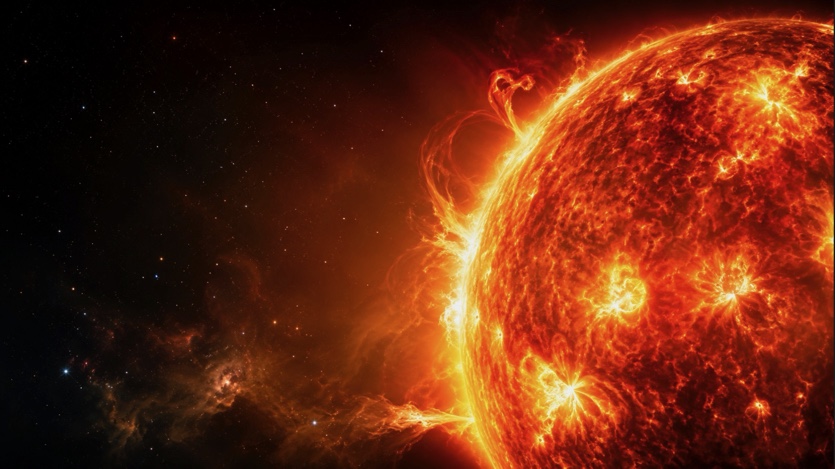
The Sun is the hottest thing most of us will ever think about, yet “how hot is it?” does not have a single answer. To understand the Sun’s temperature, it helps to look at temperature converter and unit conversion across Celsius, Fahrenheit, and Kelvin. The Sun is layered like an onion, and each layer reaches a wildly different temperature in °C, °F, and K. Even stranger, the part you might expect to be hottest is not.’t.
Below is a tour from the core out to the corona, with every temperature shown in Celsius, Fahrenheit, and Kelvin so you can see exactly how the numbers translate. Want to plug in your own values? Drop any of these into the temperature converter and switch units instantly.
The Core: Where Fusion Happens – Temperature Converter in °C, °F, and K
At the very center, gravity crushes hydrogen so tightly that nuclear fusion ignites. This is the Sun’s engine, and it’s the hottest place in the solar system.
- ~15,000,000 °C
- ~27,000,000 °F
- ~15,000,000 K
At temperatures this extreme, the difference between Celsius and Kelvin (a mere 273.15 degrees) is rounding error. Fahrenheit, however, nearly doubles the number, which is why “27 million degrees” and “15 million degrees” can describe the exact same spot.
The Radiative and Convective Zones
Energy born in the core takes a slow journey outward, first drifting through the radiative zone and then churning up through the convective zone. Temperatures fall steadily across this stretch.
- ~7,000,000 °C (≈ 12,600,000 °F / ≈ 7,000,000 K) near the inner edge
- ~2,000,000 °C (≈ 3,600,000 °F / ≈ 2,000,000 K) further out
- Cooling to roughly 5,500 °C by the time energy reaches the surface
The Photosphere: The “Surface” You Actually See
The photosphere is the glowing layer that gives the Sun its visible face. When people quote the Sun’s “surface temperature,” this is what they mean.
- ~5,500 °C
- ~9,940 °F
- ~5,780 K
This is also where the three scales feel most familiar. Convert 5,500 °C and you get a number that’s still unimaginably hot, but at least it’s not in the millions.
Sunspots: The Cool Patches
Sunspots look dark only because they’re cooler than everything around them. “Cool” is relative here, of course.
- ~3,500 °C
- ~6,330 °F
- ~3,770 K
A sunspot is still hotter than any furnace on Earth, yet it appears as a shadow against the brighter photosphere.
The Chromosphere and the Corona: The Temperature Surprise
Here’s where intuition breaks. As you move away from the Sun into its outer atmosphere, the temperature climbs again instead of dropping.
The chromosphere ranges from about 4,000 °C to 25,000 °C (≈ 7,200 °F to 45,000 °F). Above it, the corona, the faint halo visible during a total eclipse, soars to:
- 1,000,000 – 3,000,000 °C
- ~1,800,000 – 5,400,000 °F
- ~1,000,000 – 3,000,000 K
So the Sun’s outer atmosphere is hundreds of times hotter than its visible surface. Why the corona heats up like this remains one of the open puzzles in solar physics.
Quick Reference Table
| Layer | Celsius (°C) | Fahrenheit (°F) | Kelvin (K) |
|---|---|---|---|
| Core | ~15,000,000 | ~27,000,000 | ~15,000,000 |
| Radiative/convective zones | ~2,000,000–7,000,000 | ~3,600,000–12,600,000 | ~2,000,000–7,000,000 |
| Photosphere (surface) | ~5,500 | ~9,940 | ~5,780 |
| Sunspots | ~3,500 | ~6,330 | ~3,770 |
| Chromosphere | ~4,000–25,000 | ~7,200–45,000 | ~4,300–25,300 |
| Corona | ~1,000,000–3,000,000 | ~1,800,000–5,400,000 | ~1,000,000–3,000,000 |
The Formulas Behind the Conversions
Every number above comes from three simple relationships:
- Celsius to Fahrenheit: °F = (°C × 9/5) + 32
- Celsius to Kelvin: K = °C + 273.15
- Kelvin to Fahrenheit: °F = (K − 273.15) × 9/5 + 32
Notice that at solar scales, the +32 in the Fahrenheit formula and the 273.15 in the Kelvin formula barely register. They matter enormously for everyday temperatures (the difference between a fever and a freezer) but vanish into insignificance when you’re dealing in millions of degrees.
Try It Yourself
The Sun is the perfect reminder that a temperature means nothing until you know its unit. Fifteen million in one scale, twenty-seven million in another, both describing the same fiery core.
Curious what the photosphere reads in Rankine, or how a sunspot stacks up in Kelvin? Open the temperature converter, type in any value, and watch it translate across every scale at once.